Quick answer: Dental X rays let us see what an exam alone cannot, such as cavities between teeth, infection at the root of a tooth, and changes in the bone. At Finer Smiles Dental Practice, most of our patients have checkup X rays about once a year, but the timing is always personal. Some people need them every 6 months, and others every 18 months or longer. A single dental X ray uses a very small amount of radiation, about the same as a few hours of the natural background radiation we all receive every day. When we need a 3D view, for example to plan a dental implant, we may recommend a cone beam CT (CBCT) scan.
Why we take dental X rays
Many dental problems start where no one can see them. A cavity can begin between two teeth or under an old filling, an infection can form at the tip of a root, and bone loss from gum disease can start before your gums look or feel different.
X rays help Dr. Nairy Sekayan:
- Find cavities between teeth and under existing fillings
- Check for infection or an abscess at the root of a tooth
- Look at the bone that supports your teeth
- See teeth that have not come in yet, such as wisdom teeth
- Plan treatment like crowns, root canals, implants, and extractions
Finding a problem early usually means a smaller, simpler fix. A small cavity found on an X ray may need only a filling. The same cavity found years later, after it starts to hurt, may need a root canal or a crown.
Common types of dental X rays
Each kind of dental X ray shows something different.
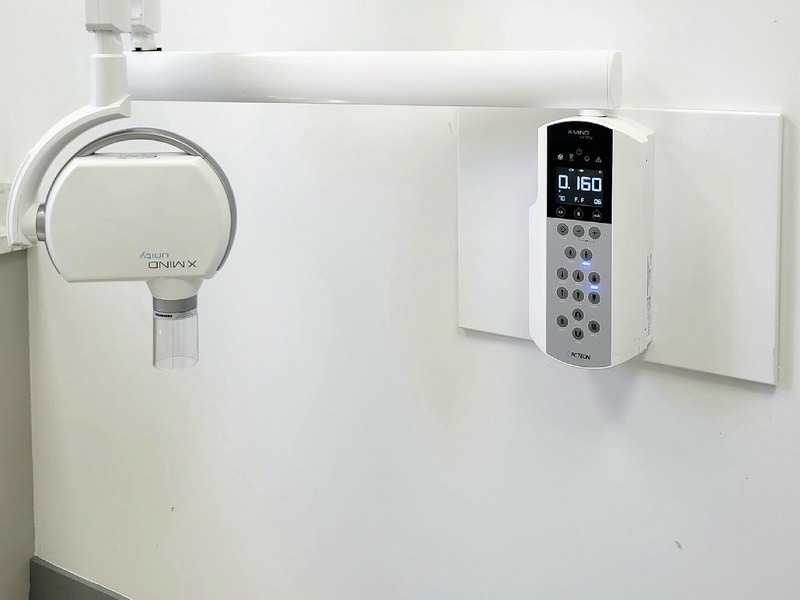
- Bitewings. You bite down on a small holder while we take the image. Bitewings show the crowns of your upper and lower back teeth together, which makes them the best way to find cavities between teeth.
- Periapical X rays. These show one or two whole teeth, from the biting edge to the tip of the root and the bone around it. We often use them when a single tooth hurts or needs a closer look.
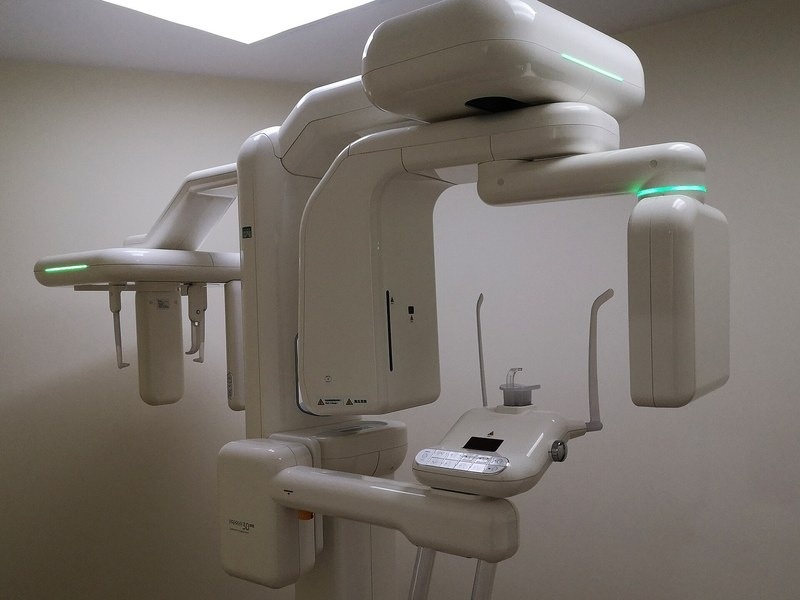
- Panoramic X rays. The machine moves around your head to show your whole mouth in one picture: all your teeth, both jaws, and the joints near your ears. It is useful for wisdom teeth and implant planning.
- A full set for new patients. When you first visit us, Dr. Nairy Sekayan may recommend a full set of X rays. This is a series of bitewings and periapical images that together show every tooth. It gives us a complete starting picture to compare against at future visits.
- Cephalometric (ceph) X rays. A side view X ray of the whole head that shows the teeth, jaws, and face together. Orthodontists use it to plan braces or aligners and to see how the teeth, jaws, and face line up. It uses a very low dose of radiation, about one day of natural background radiation or less.
- CBCT (cone beam CT). A 3D scan that we may recommend or request when a flat 2D X ray is not enough. You sit or stand still while the machine turns around your head, usually for less than a minute, and a computer builds one 3D image of your teeth, jaws, and the bone around them. It helps us plan dental implants and take a closer look at the jaw joints, the sinuses, tricky root canals, complex gum disease, and impacted teeth such as wisdom teeth. With a CBCT we can see a tooth from every angle, measure the bone, see exactly where nerves, sinuses, and roots are, and find problems that 2D X rays can miss. A CBCT uses more radiation than regular dental X rays, so we use it only when the 3D view will really help with your care.
How often do you need dental X rays?
There is no single schedule that is right for everyone, and Dr. Nairy Sekayan decides the timing for each patient. For checkup X rays (bitewings), the most common timing is about once a year. Some patients need them only every 18 months, and some need them as often as every 6 months.
How often you need X rays depends on things like:
- Your age
- How many cavities you have had, and how likely you are to get new ones
- Whether you have gum disease or a history of it
- Your fillings, crowns, implants, and other dental work
- Symptoms like pain, swelling, or sensitivity
Patients who get cavities often may need bitewings every 6 to 12 months, so we can catch new problems while they are still small. Patients with healthy teeth and gums and few cavities may go 18 months between X rays, and some may go even longer. Children and teens may need X rays more often than adults, because their teeth and jaws are still growing and changing.
If a tooth starts to hurt, we may take an X ray of that tooth at the visit. You may not need X rays at every visit, and we take them only when they will help with your care.
Are dental X rays safe?
Yes. Dental X rays use a very low dose of radiation. Digital X rays use even less than older film, and the images appear on a screen within seconds, so we can review them with you right away.
We keep the dose as low as we can by:
- Taking X rays only when they are needed for your care
- Using digital X rays
- Taking only the images that answer the question at hand
- Aiming the X ray only at the area we need to see
If you have questions about why we are recommending an X ray, please ask.
How much radiation is in a dental X ray?
We are all exposed to a little natural radiation every day, from the ground, the air, and even outer space. This is called background radiation. For the average person in the United States, it adds up to about 8 microsieverts a day (a microsievert is a very small unit of radiation dose).
Compared with that, dental X rays are very small:
- One periapical X ray is about 1 microsievert. That is roughly the same as a few hours of natural background radiation.
- A set of four bitewings is less than one day of natural background radiation.
- A coast to coast round trip flight gives you several times more radiation than a set of bitewings.
Here is a simple way to compare common dental images. These are typical estimates for adults, and the exact amount varies with the person and the machine.
| Type of image | About the same as natural background radiation for |
|---|---|
| One periapical X ray | A few hours |
| A set of four bitewings | Less than 1 day |
| Panoramic X ray | A few days |
| Ceph X ray | About 1 day or less |
| Full mouth series (about 18 images) | About 4 days to 3 weeks, depending on the equipment |
| Dental CBCT scan | Often about 3 weeks, and from a few days to about 4 months depending on the size of the scan and the machine |
| Chest X ray, for comparison | About 10 days |
As you can see, a single periapical X ray, a set of bitewings, and usually even a full mouth series use less radiation than a CBCT scan. That is one reason we use regular 2D X rays for checkups and save CBCT for times when a 3D view will truly help.
Already had X rays at another office?
If you had X rays taken at another dental office recently, you can ask that office to email them to us before your visit. If they are recent and clear, we may be able to use them instead of taking new ones.
X rays and pregnancy
If you are pregnant or think you might be, please tell us before any X rays are taken. Dental X rays can be taken safely during pregnancy when they are needed, but we will talk with you about the timing and whether an X ray can wait. Healthy teeth and gums matter during pregnancy, so keep up with your dental visits.
X rays for children
Children may need X rays more often than adults in some cases, because their teeth and jaws are still growing and cavities can spread quickly in baby teeth. X rays also help us see whether adult teeth are coming in where they should. As with adults, Dr. Nairy Sekayan recommends X rays for children only when they will help with their care, and we use the lowest dose we can.
Dental X rays in Encino
At Finer Smiles Dental Practice, your X rays are part of a complete exam with Dr. Nairy Sekayan. To schedule your checkup, call us at (818) 788 2155 or book a visit online. Our office is at 5363 Balboa Blvd #440 in Encino.
Frequently asked questions
Do I need dental X rays every year?
Many of our patients have checkup X rays about once a year, but it depends on you. Some patients need them every 6 months, and others every 18 months or longer. Dr. Nairy Sekayan will tell you what she recommends for you.
How much radiation is in a dental X ray?
Very little. One periapical X ray is about the same as a few hours of the natural background radiation we all receive, and a set of four bitewings is less than one day. Digital X rays use even less radiation than older film.
What is a CBCT scan, and why might I need one?
A CBCT (cone beam CT) is a 3D dental X ray. We may recommend or request one to plan dental implants, look at the jaw joints or sinuses, check a difficult root canal, or look at the bone around teeth in complex gum disease. It can show things a regular 2D X ray may miss.
Does a CBCT use more radiation than regular dental X rays?
Yes. A single periapical X ray, a set of bitewings, and usually even a full mouth series use less radiation than a CBCT. A dental CBCT still generally uses less radiation than a regular medical CT scan, and we recommend one only when the 3D view will truly help with your care.
Can I get dental X rays while pregnant?
Please tell us if you are pregnant or might be. Dental X rays can be taken safely during pregnancy when they are needed, but we will talk with you first about whether an X ray is needed now or can wait.
Can I use X rays from my last dentist?
Often, yes. Ask your last dental office to email your recent X rays to us before your visit. If they are recent and clear, we may be able to use them instead of taking new ones.
Why do new patients need a full set of X rays?
A full set shows every tooth, the roots, and the bone around them. It gives Dr. Nairy Sekayan a complete starting picture of your mouth, so she can find problems early and compare against it at future visits.
Sources
- American Dental Association, MouthHealthy. X Rays. https://www.mouthhealthy.org/all-topics-a-z/x-rays
- American Dental Association. Oral Health Topics: X Rays/Radiographs. https://www.ada.org/resources/ada-library/oral-health-topics/x-rays-radiographs
- American Dental Association and American Academy of Oral and Maxillofacial Radiology. Patient selection for dental radiography and cone beam computed tomography: clinical recommendations. The Journal of the American Dental Association, 2026. https://jada.ada.org/article/S0002-8177(25)00631-2/fulltext
- American Dental Association expert panel. Optimizing radiation safety in dentistry: clinical recommendations and regulatory considerations. The Journal of the American Dental Association, 2024. https://jada.ada.org/article/S0002-8177(23)00734-1/fulltext
- U.S. Food and Drug Administration. Dental Cone Beam Computed Tomography. https://www.fda.gov/radiation-emitting-products/medical-x-ray-imaging/dental-cone-beam-computed-tomography
- RadiologyInfo.org (American College of Radiology and Radiological Society of North America). Radiation Dose from X Ray and CT Exams. https://www.radiologyinfo.org/en/info/safety-xray
- RadiologyInfo.org (American College of Radiology and Radiological Society of North America). Dental Cone Beam CT. https://www.radiologyinfo.org/en/info/dentalconect
- Health Physics Society, Ask the Experts. How can I describe dental exposures to patients? https://hps.org/publicinformation/ate/q10779/
This article is general education, not a diagnosis or a treatment promise. Only an in person exam can determine what is right for your mouth.


